


Programmatic SEO helps brands target niche searches at scale, but quality and real value matter more than ever. Automated publishing has changed a lot over the past few years. What started as simple template filling has turned into something closer to structured data publishing, and for good reason. Companies sitting on rich datasets can now build landing pages that answer very specific search queries, often ones too niche for anyone to write about by hand. But the rules around programmatic SEO have shifted too, as search engines get better at telling real value apart from recycled content. Knowing where that line sits matters more than ever, because getting it wrong doesn’t just hurt one page; it can drag down an entire site.
How Search Algorithms Have Changed the Game

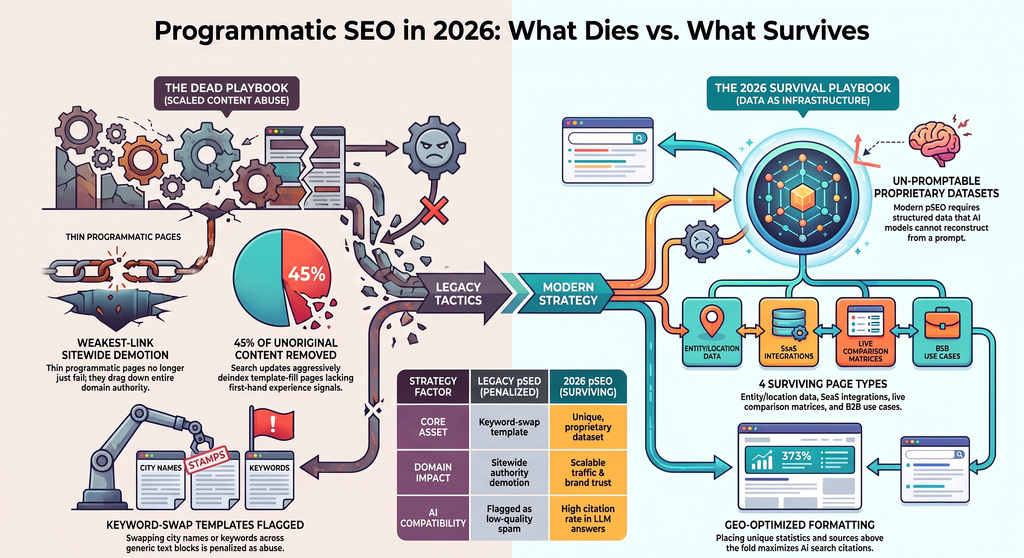
Automated SEO strategies used to rely on deploying near-identical pages with only a location or keyword swapped out. That approach doesn’t fly anymore. Search engines now run on sophisticated enough natural language models to spot repetitive templates with little original substance, and official search guidelines now explicitly call out automated pages built purely to manipulate rankings as scaled content abuse.
Recent core updates have pulled more than 45% of unoriginal content out of search indexes entirely. On top of that, AI-generated summaries now show up on roughly 60% of informational searches, cutting top-ranking click-through rates by as much as 58% on the keywords they trigger. Add to that the fact that 93% of sessions inside conversational search tools end without a single click to an outside site, and it’s clear the old playbook for scaling SEO through volume alone no longer works. Publishing thousands of thin, templated pages today is more likely to trigger a sitewide demotion than deliver traffic.
Where Programmatic SEO Still Works Well
None of this means automated publishing is dead. It just means it needs to be built on something real. The strategy still performs strongly when it’s powered by proprietary data that genuinely answers a distinct search need, functioning more like a data product than a mass-produced article. Four models tend to hold up consistently in SEO terms:
- Location- or entity-based data platforms
- Software integration directories
- Live comparison tools
- Use case-specific pages built around real business scenarios
Global financial platforms show what this looks like at scale, serving live exchange rate data across 1.7 million programmatic pages and pulling in around 54 million organic visits a month. Software integration hubs work the same way, documenting exactly how specific applications connect with each other, something users actively search for. One AI image platform used this approach to grow monthly signups from 67 to over 2,100, a 3,035% increase, in just 10 months. It did this by deploying 15,000 dynamic pages built on custom field mapping and batch publishing, growing organic traffic by 850% along the way.
Why Most Programmatic SEO Campaigns Fail

The most common failure point is a dataset that isn’t deep enough to support real pages. Swapping out a city name or a service type inside otherwise identical paragraphs creates thin content, and search engines are quick to discount or deindex it.
There’s a bigger risk hiding underneath that, though. Search algorithms evaluate quality at the domain level, not just page by page. Once a site hosts a large volume of low-value automated pages, the resulting demotion doesn’t stay contained. It pulls down rankings for genuinely strong editorial content sitting on the same domain. Data backs this up clearly: sites where programmatic pages made up 70% of location-based content saw traffic drops of more than 78% during major algorithm updates, while purely editorial sites saw flat or even positive movement. Recovery is brutal too. Fewer than 22% of sites hit by a scaled content demotion ever regain their previous visibility, even after cleaning up the offending pages.
What It Actually Costs, and What It Returns
Before committing to programmatic SEO, it’s worth weighing the infrastructure cost against likely conversion gains. Most setups rely on a stack of specialized tools, typically including:
- Database synchronization systems starting around $149 a month
- Workflow automation engines starting around $499 a month
- WordPress import tools priced near $99 a year
When these pages are built well, with tailored previews and a clear call to action above the fold, conversion rates can jump from around 10.4% to 24.8%. There’s also a newer angle worth factoring in: pages built with generative engine optimization in mind, meaning they embed verified statistics and clearly sourced data points, have been shown to increase AI search citations by up to 40%.
Building a Dataset That Actually Holds Up

Sustainable programmatic SEO comes down to dataset quality and proper validation before anything goes live. Reliable data should come from solid primary sources, things like government census records, OpenStreetMap coordinates, public regulatory databases, or a company’s own product usage logs.
A few structural habits make a real difference:
- Give each published URL exactly one matching dataset row to avoid canonical conflicts
- Use consistent, underscored naming across columns so templates render properly
- Keep raw numeric values separate from formatted text
- Maintain a publish status column to manage scheduling and review
- Track a last updated timestamp for anything time sensitive
Before launch, it’s worth running a few checks. Confirm there are no duplicate values in primary variables. Make sure mandatory fields are filled in at least 95% of the time. Check that sample text across rows stays under 70% structural similarity. And do a manual spot check on pricing and feature accuracy against the original source data.
Weighing the Trade-Offs
What works in its favor:
- Fast expansion across long-tail keyword variations without heavy per-page writing costs
- Access to high-intent commercial searches competitors often miss
- A scalable lead generation setup when paired with a solid product database
What to watch out for:
- The whole domain is exposed if dataset quality slips
- Ongoing maintenance is real, from API monitoring to keeping data fresh
- Generative search summaries are already eating into organic clicks for simpler queries
Where This Leaves Programmatic SEO Going Forward
The organizations getting real value from this approach treat their page sets as governed products, not one-off publishing experiments. That means sourcing solid proprietary data before designing a single template, setting clear quality thresholds, adding structured schema markup, and regularly pruning pages that aren’t pulling their weight. Done properly, programmatic SEO still offers a genuine path to sustainable organic growth. Done carelessly, it’s one of the fastest ways to damage a domain’s search visibility for years.
Read More