
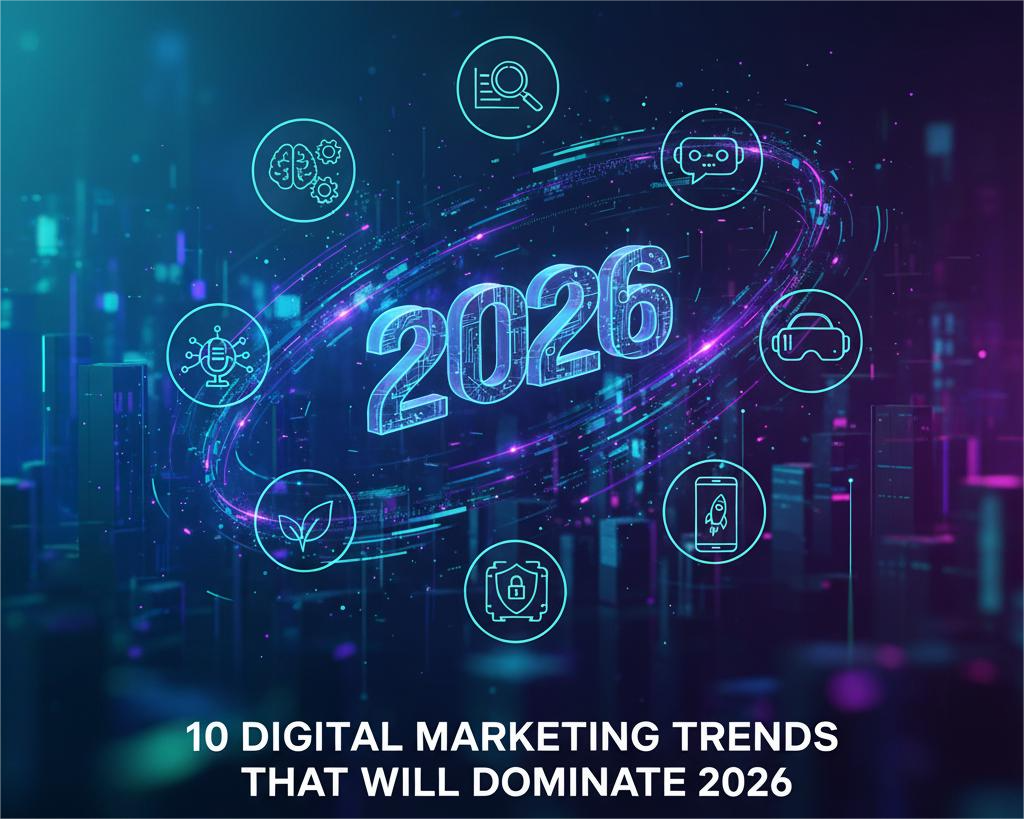
Top Digital Merketing Trends
In today’s fast growing world, AI in digital marketing is dominating the entire industries that helps the marketers to make different strategies that became trend.
Digital marketing is evolving at an incredible pace, and brands that adopt AI integration and uphold ethical practices will emerge victorious in 2026.
Multimodal search is changing how consumers discover brands. Consumers now expect instant, relevant results when asking complex questions aloud, snapping photos of products or inputting vague image-based queries – all while expecting instantaneous and relevant answers from multimodal searches.
1. AI in Marketing
Machine learning algorithms use large data sets to identify consumer trends and present relevant ads that minimise digital marketing waste while increasing ROI.
Content creation that engages and captures audience attention requires interactive formats like quizzes and AR/VR experiences – tools which are key for engaging viewers.
Marketers must disclose their use of artificial intelligence (AI) to establish trust with consumers and alleviate any negative backlash related to its implementation. AI is no mere trend – it is an integral component of any business’s operations and needs to be treated as such.
2. Omnichannel Experiences
Omnichannel business models allow customers to interact with organizations on their terms, using any channel. This gives customers a sense of being Connected rather than Disconnected from an organization through different communication methods.
At Sephora, for instance, shoppers can shop online and pick up in-store or curbside – with data combined from both digital and physical loyalty accounts to create an even more tailored shopping experience. In addition, user-generated content like Instagram customer photos or Reddit threads that praise products has also become part of this trend.
3. AI-Powered Answer Engine Optimization (AEO)
AEO (Search Engine Optimization) is a subset of SEO that specializes in tailoring content directly to search engine queries. AEO increases visibility across search engines, voice assistants and multimodal platforms such as Google Lens.
Modern consumers expect quick and convenient answers to their inquiries. This technology meets that need effectively.
Visibility on AI search engines like ChatGPT and Perplexity is rapidly shifting the point at which people first become aware of your brand. HubSpot’s AEO Strategy (private beta) ensures your content can reach these answer engines by grading readiness, offering insights, and prioritizing action needed to fill gaps with on-brand material.
4. Geolocation
Geolocation technology identifies the location of devices and people. This can range from GPS tracking to Wi-Fi network triangulation and more.
Business has many advantages to gain from using geolocation data, including increased efficiency and security benefits. But the technology also poses privacy concerns because of its potential to identify a person’s location. To address these concerns, enterprises must create internal policies and educate employees. Training programs on how apps and devices collect, store and share geolocation information should also include detailed privacy and security safeguards to avoid privacy violations.
5. AR Experiences
Augmented reality (AR) allows marketers to layer digital information and experiences onto the real world. AR technology is widely available on consumer devices like smartphones and tablets as well as more specialized eyewear such as headsets and glasses.
Retail brands use AR to enable virtual try-ons of clothing products and furniture in home settings. Pokemon GO users, for instance, can access sponsored AR experiences within the game to collect in-game rewards; other retailers leverage AR technology to reduce return rates by providing customers with virtual views and trials of 3D models before making a purchase decision.
6. AI-Powered Account-Based Marketing (ABM)
ABM treats key accounts like markets of one, creating highly personalized marketing campaigns. Closed loop analytics and AI ensure high-touch engagement that drives sales growth and revenue gains.
AI-Powered Tools Facilitate Effective Personalization
AI-powered tools make personalization more effective by allowing marketers to deliver content tailored to each target account more easily. Furthermore, these automated ABM processes and workflows decrease manual efforts while freeing up team members to focus on more strategic activities.
Expect to see more AI discovery tools like Pinterest’s advanced virtual try-on tools which match clothing products to specific body types.
7. One-Tap Checkout
Have you ever witnessed a full cart vanish just prior to checkout, even when everything seemed in place to sell them on buying? Your customer was convinced, you presented products well, advertised promotions effectively and optimized your PDP plan…yet they still chose not to make the purchase!
One-click checkout helps your business increase sales by decreasing cart abandonment rate and strengthening customer relationships, plus by providing easier repeat purchases via stored payment methods. It’s a win-win solution for marketers and shoppers – find out how to implement this digital marketing trend now!
8. Shoppable Video
Brands can now incorporate product details and purchasing opportunities directly into their video content, providing customers a smooth journey from discovery to purchase with minimal friction in the purchasing journey. Shoppable videos offer direct paths between discovery and purchase that minimize friction during their buying journey.
These shopping experiences have proven highly successful at engaging audiences, particularly for products with minimal barriers to conversion such as clothing and beauty items. Furthermore, they allow brands to build trust by engaging them on an emotional level.
Ecommerce brands that wish to create interactive video content can increase engagement and sales by turning passive viewing into active participation, through quizzes, polls and interactive video ads.
9. Employee Advocacy
Digital marketing landscape is evolving from brand to people-centric. Visibility and engagement-focused KPIs will take center stage for digital marketing strategies by 2026.
Employee advocacy can help achieve your business objectives. Start by securing leadership buy-in and setting clear goals for your program, then offering user-friendly advocacy tools to centralize content, automate sharing, measure participation, and engage audiences through humanised storytelling; such as customer stories that resonate, thought leadership efforts or commemorating special observances.
10. Authentic Storytelling
Authentic storytelling isn’t just a marketing trend; it’s a fundamental strategy for brands looking to build trust with customers, differentiate themselves, humanize their image, drive sales and conversions and ultimately increase revenues.
Examples include Dove’s “Real Beauty” campaign, which challenged societal beauty standards; and Airbnb’s “Belong Anywhere” initiative, which highlighted travel’s transformative power.
Brands that connect emotionally with their audiences will develop deeper relationships, increase loyalty, and maximize lifetime value. Evoking emotions within audiences will generate deeper relationships, increased loyalty, higher engagement rates, higher visibility metrics, performance measures as well as new opportunities to repurpose content across channels.