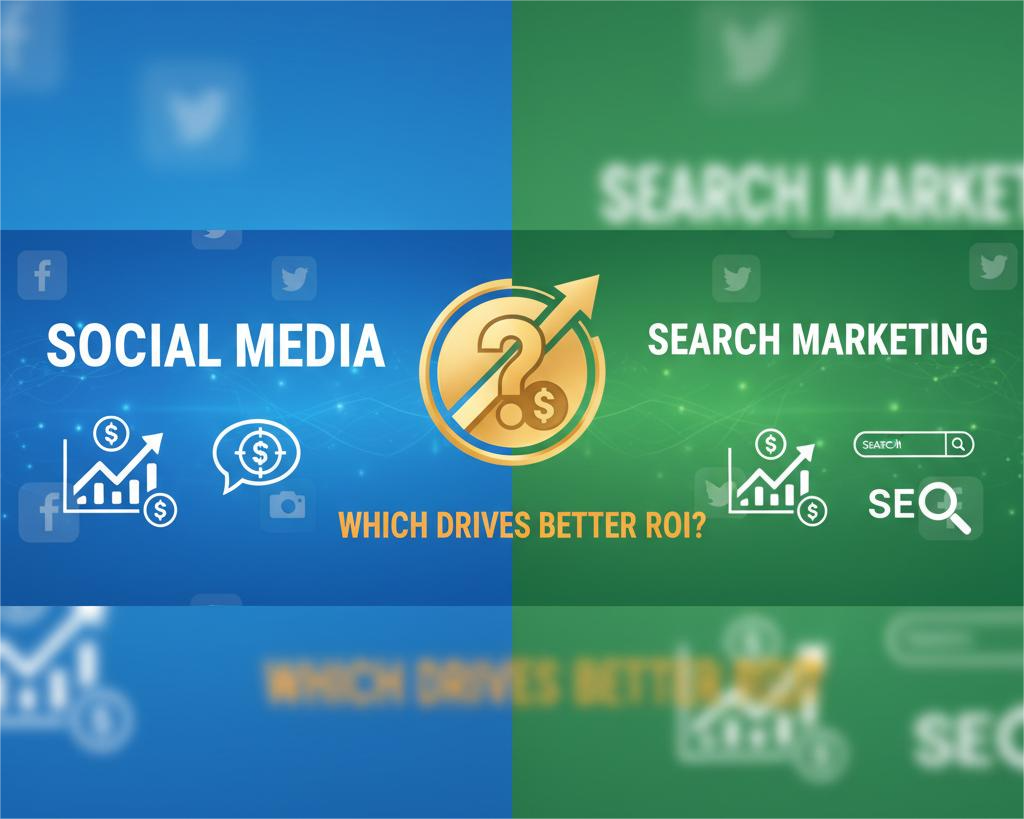

In the dynamic world of technology, the more digital marketing strategies you have the more you get ROI, sometimes businesses face a critical choice when allocating their advertising spend: social media marketing vs. search marketing. Both channels offer immense potential for audience reach and engagement, but the ultimate question for any data-driven marketer is simple: Which drives better ROI (Return on Investment)?
The truth is, there is no single, universally superior answer. Instead, the optimal choice—or, more accurately, the optimal blend—depends entirely on your business objectives, your target audience’s behavior, and the stage of the customer journey you are trying to influence. A thorough digital marketing ROI comparison reveals that each channel excels at different parts of the marketing funnel.
Search Marketing: Capturing Intent and Driving Conversions
Search marketing, encompassing both SEO (Search Engine Optimization) and PPC (Pay-Per-Click) advertising like Google Ads, is fundamentally about capturing intent. Users who turn to a search engine are actively looking for a solution, a product, or a piece of information.This high-intent state gives search marketing a distinct advantage in driving high-quality leads and immediate conversions.
SEO vs. Social Media Marketing: The Long-Term Game
SEO is the long-term pillar of search marketing. Its value proposition is simple yet powerful: free, high-quality, sustainable traffic.
- Long-Term ROI: While the initial investment in content marketing ROI, technical optimization, and link building is significant, a successful SEO strategy compounds over time.Unlike paid campaigns that stop when the budget runs out, a top-ranking organic result provides consistent, non-expiring traffic and leads, dramatically lowering the Customer Acquisition Cost (CAC) over the long haul. Studies suggest that organic search often delivers the best marketing channel for ROI for businesses focused on sustainable growth and authority.
- Trust and Credibility: Users inherently trust organic search results more than paid advertisements.chieving a top organic rank builds strong brand credibility, leading to higher click-through rates (CTR) and better conversion rates from organic traffic.
PPC vs. Social Media Ads: Speed and Precision
PPC is the immediate, results-driven component of search marketing.
- Conversion Intent: When a user types a specific commercial query (e.g., “buy leather sofa online”), a relevant PPC ad intercepts them at the precise moment of purchase intent. This is the bottom-of-the-funnel strategy. Consequently, PPC campaigns often boast significantly higher conversion rates than traffic generated from social platforms, which typically target a less immediate buying mindset.
- Measurability: The ROI for PPC is highly granular and immediate. Metrics like Cost Per Click (CPC), Cost Per Acquisition (CPA), and overall campaign ROI are tracked in real-time, allowing for rapid A/B testing and optimization. This makes it a perfect channel for performance marketing analysis and quick revenue generation. The general consensus for Google Ads is a strong return, often cited as $2 for every $1 spent, but top campaigns perform far better.
Social Media Marketing: Building Awareness and Engagement
Social media marketing, spanning both organic content and social media ads, is an outbound strategy focused on injecting your brand into a user’s feed while they are primarily focused on connecting with friends, consuming entertainment, or professional networking.
Brand Building and Audience Reach
Social media is unmatched in its ability to generate brand awareness and foster a loyal community.
- Top-of-the-Funnel Excellence: Social platforms are the ideal place to introduce your brand, share stories, and build an emotional connection. Metrics like engagement rate, reach, shares, and follower growth are key to measuring this early-stage, long-term brand equity, which is harder to quantify in immediate ROI terms but is crucial for long-term customer lifetime value (CLV).
- Hyper-Targeting: The paid side of social media, such as Facebook or Instagram Ads, offers unparalleled targeting based on detailed demographics, interests, and behaviors. This allows for brilliant segmentation, retargeting of website visitors, and audience lookalikes. While the users may not be actively searching to buy, the ad can be so precisely targeted that it creates demand where none existed moments before.
Traffic vs. Conversions: The Funnel Difference
A key distinction in the social media marketing vs search marketing debate lies in the customer journey.
- Social Traffic: Traffic from social media is generally considered mid-to-upper funnel. It’s excellent for driving users to blog content, signing up for a newsletter, or engaging with a brand’s personality. While Cost Per Click (CPC) on social ads can often be lower than on search platforms, the conversion rate from that traffic is frequently lower because the intent isn’t as high.
- The Conversion Challenge: The challenge for social media ROI lies in direct conversion attribution. A user might see an ad on Instagram, click it, leave, and then later search for the brand name on Google to buy. The sale will be attributed to Search, obscuring social media’s role in the initial awareness and nurture.
The Best Marketing Channel for ROI: A Unified Strategy
To determine which channel drives the “better” ROI, we must consider the full picture.
| Feature | Search Marketing (SEO/PPC) | Social Media Marketing (Organic/Paid) |
| Primary Goal | Direct Conversions, High-Intent Leads | Brand Awareness, Community, Engagement |
| Customer Journey Stage | Middle to Bottom of Funnel | Top to Middle of Funnel |
| Time to See ROI | SEO: Slow (6-12+ months). PPC: Immediate. | Organic: Slow/Variable. Paid: Immediate. |
| Traffic Quality | High Intent (Actively Searching) | Mixed (Interruptive, Interest-Based) |
| Cost Dynamics | SEO: High initial time/resource cost, low long-term running cost. PPC: High per-click cost. | Organic: High content creation cost, low distribution cost. Paid: Lower CPC, but lower conversion rate. |
Synergistic ROI
The most sophisticated and profitable digital marketing ROI comparison concludes that the highest ROI comes from using both channels synergistically.
- Search for Demand Capture (Conversions): Use SEO and PPC to capture the sales-ready customers who are actively looking for you right now. This is your primary conversion engine.
- Social for Demand Creation (Awareness): Use social media to build your brand, engage your audience, and push valuable content marketing assets (videos, articles) to create future demand. These channels nurture prospects until they are ready to search for your solution later.
- Retargeting: Social media’s powerful retargeting capabilities allow you to show highly personalized ads to people who visited your site via an SEO or PPC campaign but didn’t convert. This lower-funnel application of social ads often yields excellent performance marketing returns by closing the loop.
In conclusion, search marketing is the more reliable source for immediate, measurable, and high-converting ROI because it intercepts users with high purchase intent. However, a business that solely relies on search will find its growth capped by market demand. Social media marketing, while harder to attribute to direct sales, builds the brand recognition and customer loyalty—the lifetime value—that feeds the search engine demand of the future. The ultimate winner in the ROI battle is the strategy that integrates both SEO vs social media marketing efforts into a cohesive, funnel-spanning system.