

For two decades, home search followed a predictable path. Buyers typed a query into Google, clicked through to Zillow, Realtor.com, or Homes.com, scrolled through listings, and only then reached out to an agent. Portals controlled that whole journey, and they charged for it too, sometimes taking up to 40% of an agent’s commission just to hand over a lead.
That path is starting to break down. Google isn’t content sending traffic elsewhere anymore. It wants to be the destination itself, and it’s building the tools to get there, dropping live listings, map tours, and direct contact buttons straight into the search results page. For agents, teams, and brokerages, understanding this shift isn’t optional anymore. It’s becoming a basic requirement for staying visible.
Google’s approach here isn’t complicated. Own the top of the results page, show listings directly, and let the older portals become optional rather than essential. This playbook already worked in travel, hotel booking, and local reviews, where established platforms lost both traffic and pricing power once Google moved in. Real estate is next.
Bypassing the Middlemen
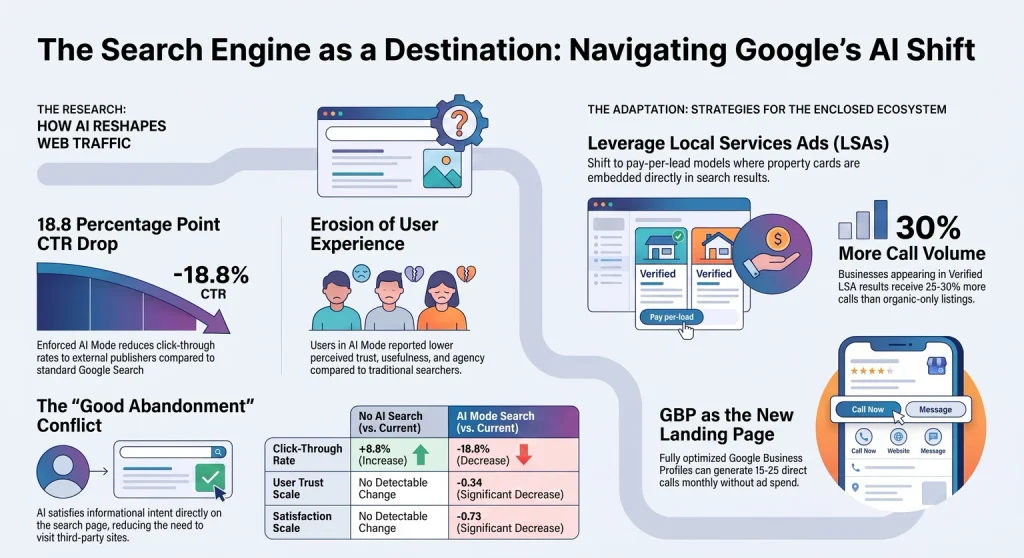
The shift became obvious when Google expanded its Local Services Ads to cover home listings nationally. Someone searching “homes for sale near me” on their phone now sees property cards complete with photos, prices, and details, plus a button to call or message a local agent directly. Portals get cut out of the process entirely.
Markets noticed. Zillow dropped 4.9% and CoStar fell 3.6% on the announcement, building on an earlier test in late 2024 that had already pushed Zillow down more than 8% and CoStar down 6.4%. Analysts are warning that if Google keeps expanding direct listings, the big portals could lose their place as the default starting point for home search.
Zero-Click Search and AI Answers Are Accelerating the Trend

Zero-click search is the real engine behind all this. By early 2026, 68.01% of Google searches in the US ended without a click to an outside site, up from 60.45% just two years earlier. AI Overviews, which launched in May 2024, and AI Mode, which followed in March 2025, are a big part of why. When either one appears, click-through rates to third-party sites drop sharply, down 61% for organic results and 68% for paid ones.
The effect on AI-powered search is even more pronounced. One study looked at over 1,500 sources cited by ChatGPT in response to real estate questions. Zillow and Realtor.com showed up zero times. Instead, 98.1% of citations pointed straight to an agent’s own website or their Google Business Profile. Portals aren’t just losing traffic here; they’re being left out of the conversation altogether.
A Different Way to Pay for Leads
Google’s Local Services Ads run on a different payment model than what portals typically charge. Traditional portals bill flat monthly fees or charge per click, with no guarantee that any of it turns into a real conversation with a buyer.
LSAs work differently. There’s no charge for impressions or clicks, only for actual contact, a phone call, or a message sent through the ad itself. No response, no charge. Agents can also dispute leads that turn out to be spam or wrong numbers and get credited back. Because these leads tend to come from buyers further along in their search, the results tend to be stronger too. Google’s own data shows businesses running LSAs get 25% to 30% more calls than those relying on organic listings alone.
Seeing Properties in 3D
Photos only tell part of the story. Understanding a property properly means understanding the land around it, the slope of the yard, what’s nearby, how the block sits, and standard listing photos rarely capture any of that.
Google’s 3D Maps are addressing this gap. In November 2025, Realtor.com rolled out a feature called FlyAround, built on Google’s 3D Maps platform, letting buyers virtually fly around a listing instead of relying on costly drone footage. It’s a meaningful upgrade for evaluating lot lines, terrain, and proximity to main roads, and it led to mobile map engagement roughly doubling. As Google folds more AI into Maps, buyers can now pull up nearby schools, parks, and transit links without leaving the search results, which makes Google an increasingly natural place to evaluate a property from the start.
Why Your Google Business Profile Matters More than Ever
Local intent drives a huge share of search activity, close to 46% of all Google queries. On mobile, the numbers are even sharper: 76% of people who search “near me” visit a related business within a day, and 88% follow through with a call or visit within a week.
An optimized Google Business Profile puts an agent in that valuable local map pack. Complete profiles average 50 calls a month, come across as 2.7 times more trustworthy, and lift purchase consideration by 50%. A verified profile is also a prerequisite for running LSAs, so it’s really the foundation everything else builds on.
Weighing the Advantages and the Friction
There’s genuine upside here. The pay-per-lead model protects marketing budgets since agents only pay for real inquiries, and those inquiries tend to come from buyers at a high point of intent. A strong local profile lets smaller teams outrank national brokerages in map results, and the Google Screened badge adds instant credibility with new prospects.
There’s friction too. The enhanced listing format is currently limited to CRMLS, San Diego MLS, and My State MLS, so many agents can’t access it yet. Some buyers find AI Mode’s chat responses long-winded and feel they’ve lost a bit of control over their own search. And LSAs come with real pressure attached, since slow responses to calls or messages can quietly damage an agent’s ad ranking over time.
What Agents Should Actually Do

A few moves matter more than the rest. Filling out every field on a Google Business Profile, choosing precise categories, and listing exact service areas all help. Building review velocity matters too, aiming for somewhere between 25 and 50 five-star reviews to strengthen local rankings. Publishing verifiable numbers, transaction volumes, years in the business, and awards gives AI engines something concrete to cite. And getting LSA verified early means being ready the moment a local MLS partners with Google, rather than scrambling afterward.
Final Thoughts!
The traditional home search path is quietly falling apart. By pulling live listings, pay-per-lead ads, and 3D maps directly into its results, Google is turning itself into the primary real estate portal rather than just a gateway to one. That’s a serious threat to the lead-selling model portals like Zillow and Realtor.com have relied on for years. For local agents, though, it’s an opening. Building out a strong Google Business Profile, keeping reviews coming in, and putting real numbers on a website all add up to a path around the old portal fees, straight to the buyer.
Frequently Asked Questions
Is this live everywhere in the US?
LSAs run in all 50 states, but the enhanced property card display depends on a data partnership between Google and the local MLS, currently limited to CRMLS, San Diego MLS, and My State MLS. Standard LSA ads still work outside those areas.
Do reviews actually affect ad performance?
Yes, Google factors review count and star rating directly into how LSAs rank, so higher-rated, verified agents show up more prominently.
How is this different from regular Google Ads?
Standard Google Ads charges per click regardless of outcome. LSAs only charge when a lead actually calls or messages, and they come with a Verified badge that standard ads don’t offer.
Do I need a physical office to set up a profile?
No, agents can register as a service area business, which keeps a home address off Google Maps while still listing the specific cities and neighborhoods served.
How long does verification take?
Usually two to four weeks, covering license confirmation, business validation, and a background check. Starting early avoids delays later.
