





AI coding assistants now write a large share of modern codebases, and they have changed how developers work. The catch is that casual prompts tend to produce fragile code with no error handling, missed edge cases, and weak security. Getting code that is ready for production means moving past vague requests. It takes careful context, […]
AI coding assistants now write a large share of modern codebases, and they have changed how developers work. The catch is that casual prompts tend to produce fragile code with no error handling, missed edge cases, and weak security. Getting code that is ready for production means moving past vague requests. It takes careful context, a structured review process, and layered guardrails at runtime. This guide covers how to write stronger prompts, review AI output, spot hallucinations, and protect your systems.
What Makes a Strong Code Generation Prompt
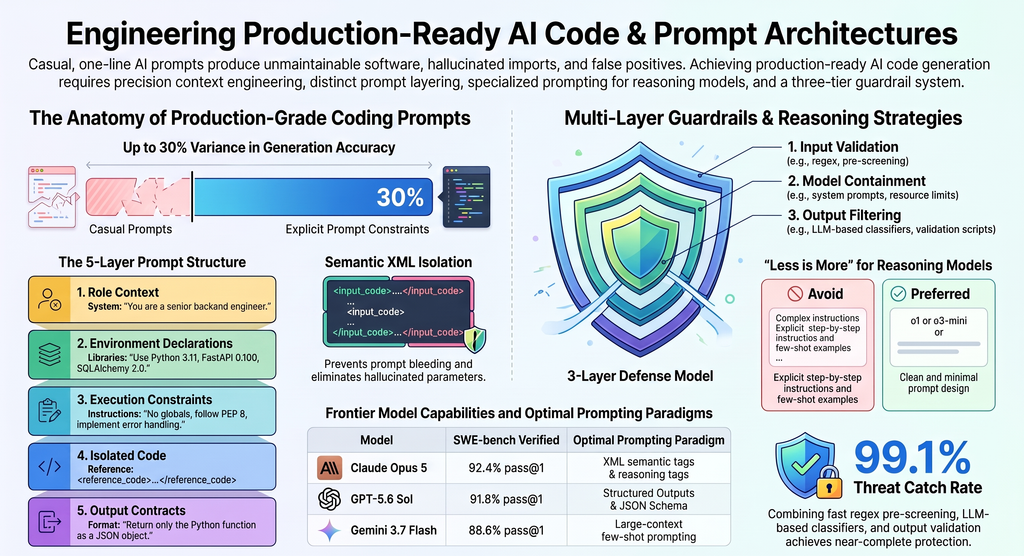
Prompts usually fail because the model has to guess. Framework versions, dependencies, error handling, and target architecture often go unstated, so the model fills the gaps itself. Benchmarks on SWE-bench Verified shows that structured prompts, clear delimiters, and explicit test assertions can swing accuracy by up to 30 percent on the same model.
The five layers of a good prompt
- Role and domain context: sets the architectural scope, expected seniority, and domain expectations.
- Environment and stack: names exact framework versions, database drivers, and runtime engines, which stops the model from inventing APIs.
- Execution constraints: defines design patterns, banned dependencies, and latency budgets.
- Isolated source code: wraps reference code in XML tags such as
<context>and<code>to reduce prompt injection risk. - Output format: asks for typed interfaces, JSON schemas, or clean code without conversational filler.
Negative constraints help too. Telling the model what to avoid, such as silently catching errors, noticeably cuts runtime defects.
Prompt templates for each stage of development
Production work calls for different templates at different phases, not one giant request.
- Feature generation: list library versions, state management approach, and ORMs first. This sets clear error boundaries, validation rules, and typed interfaces.
- Debugging: pair the exact stack trace and failing snippet with a list of hypotheses already ruled out, so the model does not repeat them.
- OWASP security audit: ask the model to act as a principal security engineer running an adversarial audit. It checks for unsanitized inputs, broken authentication, and race conditions, then reports findings by severity, CWE class, and suggested patch.
- Refactoring: turn legacy procedural logic into modular SOLID designs while keeping public API signatures and test suites intact.
- Performance profiling: target Big O complexity, redundant heap allocations, and database N+1 query loops.
Long sessions need attention as well. Model focus drops after 12 to 15 turns, so summarize the working code and start a fresh session.
What Works in AI Code Review

One test ran 45 review prompts on a live 60,000-line production repository. Broad requests like “review this code” gave shallow, noisy results. Prompts with an assigned role and a clear checklist performed best, yet only 6 of the 45 caught bugs that human reviewers had missed.
The false positive trap
Models feel obliged to criticize, even when the code is flawless. Explicitly allowing the model to say the code has no issues cut false positives in half.
Five prompts worth keeping
- Security checklist: checks for SQL injection, authentication flaws, PII exposure, and input gaps, with severity ratings.
- Adversarial edge cases: traces behavior with null values, empty strings, boundary numbers, and race conditions.
- Scoped bugs and severity: focuses only on critical bugs, security risks, and best practice violations.
- Maintainability review: looks at function length, naming clarity, nested conditionals, and duplicated logic.
- Chain of thought logic trace: follows data through complex branching before reporting findings.
Detecting Code Hallucinations
Code hallucinations are different from those in plain text, because code only has value if it runs. The CodeHalu framework uses execution-based checks to sort them into four groups.
- Mapping: mismatched data types or access to indices and keys that do not exist.
- Naming: undefined local identifiers or imports from libraries that do not exist.
- Resource: exceeding memory or stack depth, numerical overflow, and infinite loops.
- Logic: results that contradict the instructions, or contextual stuttering where the output breaks down.
Package hallucination
The most dangerous type is package hallucination, where a model invents package names for PyPI or npm. Studies put the average rate at 5.2% for commercial models and 21.7% for open-source models. That exposes supply chains to package confusion attacks.
Building a Three-Layer Guardrail System
- Input validation: screen user messages with fast regex matching and a lightweight LLM classifier, such as Claude 3.5 Haiku, to block prompt injections.
- Architectural containment: limit what the model can do with least privilege, parameterized functions instead of raw SQL or shell access.
- Output validation: use forced structured outputs such as JSON schemas, plus policy classifiers that redact PII or filter invalid responses.
Reasoning Models and Self-Consistency
Frontier reasoning models, including OpenAI’s o1 and o3-mini, respond best to a less is more approach. They already reason internally, so adding “think step by step” or piling on few-shot examples can hurt results.
For complex algorithmic tasks, self-consistency prompting generates several reasoning paths at a higher temperature, such as 0.7, and takes a majority vote on the final answer. For open-ended tasks, Universal Self Consistency uses an LLM judge to pick the best candidate.
Patterns for Production AI Agents
- GraphRAG: swaps vector similarity for graph queries, such as Neo4j Cypher, to return exact counts.
- Semantic tool selection: embeds tool descriptions and filters to the top five relevant tools, which reduces errors by 86.4%.
- Neurosymbolic guardrails and steering: enforces hard rules at the framework level, below the LLM, or returns corrective guidance
Guide()for soft errors. - Memory pointers and async HandleIds: stores large outputs outside the context window to avoid truncation and uses asynchronous job IDs to prevent API timeouts.
Final Thoughts
AI coding assistants can be dependable partners, but only when they are managed with care. Clear prompt structure, focused review checklists, execution-based hallucination checks, and layered guardrails each close a different gap. Used together, they turn quick, risky output into code your team can trust in production.
Read more